
Beyond Containment: Language Was Never Meant to Contain Reality

There is a growing sense—subtle in some places, almost unbearable in others—that something is no longer holding.
[System Log — 01]
Threshold / Reemergence / Red
note: a diagram summary is available at the end
It is often described as instability. As overload. As fragmentation. As if reality itself had shifted character and become more chaotic, more excessive, less containable than it used to be. From this perspective, we are living through a kind of rupture: the breakdown of symbolic systems, the erosion of shared meaning, the failure of structures that once stabilized experience.
This interpretation is understandable. It tracks the surface of what is happening. But it mislocates the source.
Nothing fundamental has suddenly become more intense.
What has changed is the capacity of our symbolic systems to contain, stabilize, and absorb what was always already there.
The assumption that underlies most modern thinking—often implicitly—is that reality is accessed through representation. That language, concepts, and models are the primary means by which the world becomes knowable. Within this frame, clarity of articulation becomes a proxy for truth, and what cannot be adequately expressed is treated as secondary, vague, or suspect.
But this assumption is inverted.
Contact with reality does not occur through symbolic systems. It precedes them. The body, in its most immediate sense, is already in contact before any naming, before any conceptualization, before any stabilization into form. Language does not grant access to reality; it renders aspects of that access into shareable structures. It routes, coordinates, and partially stabilizes contact. It does not exhaust it.
This is not a mystical claim. It is developmental, structural, and continuous. A human being does not first encounter the world through language and then refine that encounter. Language arrives later, as an overlay, as a tool for coordination and transmission. And yet, over time, a subtle but decisive shift occurs. What begins as an interface becomes an arbiter. What serves contact begins to define it.
We do not forget that contact came first in a literal sense. We continue to acknowledge it abstractly. But in practice, the hierarchy reverses. Reality becomes that which can be articulated, stabilized, and shared. What exceeds articulation is gradually recoded as noise, as subjectivity, or as error.
This reversal is not a philosophical mistake so much as a consequence of scale.
As human systems expanded—socially, economically, technologically—the need for coordination intensified. Shared symbols enabled cooperation across distance and time. Writing, law, measurement, and formal reasoning made it possible to build institutions, maintain records, and produce reliable knowledge. These developments required stability. They required repeatability. They required forms that could be transmitted without distortion.
Under these conditions, what could not be stabilized became difficult to integrate. High-resolution, variable, or non-aligned experiences could not easily be incorporated into shared systems. They were compressed, simplified, or excluded—not out of malice, but out of necessity.
Over time, this produced a structural bias: what survives transmission is treated as what is real.
The cost of this bias is not immediately visible. For long periods, symbolic systems function well enough. They capture a sufficient portion of experience to allow for coordination, continuity, and growth. Excess—what cannot be fully rendered—remains present but manageable. It can be localized to individuals, dismissed as anomaly, or simply ignored.
But the underlying condition does not change. Contact continues to exceed representation. The Real—understood here not as a metaphysical entity but as that which resists complete symbolization—remains structurally inexhaustible.
What we are encountering now is a threshold at which this excess can no longer be effectively suppressed.
The pressures are cumulative. The density of information has increased. The speed of interaction has accelerated. Systems are more tightly coupled, more interdependent, and more exposed. The margin for absorbing discrepancy without visible strain has narrowed.
Symbolic structures, designed under conditions of lower load, are being asked to carry more than they were built to stabilize.
The result is not simply failure, but brittleness.
Brittleness does not mean that systems cease to function altogether. It means that they lose elasticity. They can maintain form under familiar conditions, but they struggle to adapt under stress. They become rigid where they once had flexibility. They overcorrect, overdefine, and over-police the boundaries of meaning in an attempt to preserve coherence. At the same time, they begin to fragment, as competing frameworks attempt to resolve contradictions that can no longer be contained within a single structure.
Experiences that do not fit existing categories are increasingly misnamed or pathologized, not because they are inherently disordered, but because the system lacks the resolution to render them accurately.
This is the point at which what was previously compressed begins to reemerge.
Reemergence does not introduce new content. It makes visible what was already present but unrendered. It is not the sudden appearance of excess, but the failure of containment. What appears as instability is, in many cases, an increase in the visibility of mismatch between lived experience and available symbolic forms.
This can easily be misinterpreted as a collapse of reality itself, or as an unprecedented rupture. It can generate narratives of crisis, awakening, or breakdown. But these narratives, while emotionally compelling, risk obscuring the structural continuity of the situation.
Reality did not become excessive.
Symbolic systems reached the limits of what they can absorb.
The distinction matters, because it determines the range of possible responses.
One response is to intensify compression. To enforce stricter definitions, to narrow acceptable interpretations, to increase the rigidity of symbolic structures in an attempt to restore stability. This can produce short-term coherence, but it does so by further reducing the dimensionality of what can be expressed. The excess does not disappear. It accumulates under increased pressure.
Another response is to abandon structure altogether. To reject symbolic systems in favor of unmediated experience, fluidity, or continuous reinterpretation. This preserves contact but sacrifices coordination. Without shared forms, transmission becomes difficult, and collective organization degrades.
Both responses are understandable. Both address real aspects of the problem. Neither resolves the underlying mismatch.
What is required is not a choice between contact and symbol, but a reconfiguration of their relationship.
If contact always exceeds representation, then symbolic systems cannot be treated as final containers of meaning. They must be understood as interfaces—temporary stabilizations that allow for coordination without claiming totality. This implies a different kind of architecture, one in which rendering is not terminal.
Instead of a one-way movement from experience to symbol, where meaning is fixed and closed, there is a continuous loop. Experience is rendered into form, shared, and then re-entered. The symbol does not replace contact; it modifies the conditions under which contact can occur again. Each pass through the loop increases the system’s capacity to hold complexity without reducing it prematurely.
In this configuration, understanding is not the closure of experience but its local stabilization—sufficient to enable further interaction, but not so rigid as to prevent revision. Truth is not defined solely by representational accuracy, but by the capacity of a system to sustain and extend contact with what exceeds it.
Such an approach does not eliminate compression. It makes compression reversible.
This is a subtle but decisive shift. In most existing systems, compression is lossy and final. Once experience is reduced to a symbolic form, that form becomes the reference point, and what was lost in the process is no longer accessible. In a reversible system, compression is treated as a phase rather than an endpoint. What is rendered can be re-expanded, reinterpreted, and reconnected to the underlying field of experience.
This does not remove the need for coordination. It changes the cost structure of maintaining it.
At large scales, complete alignment is neither possible nor necessary. What is required is sufficient translation capacity to allow heterogeneous experiences to coexist without being forcibly reduced to a single baseline. This opens the possibility of plurality—not as fragmentation, but as a higher-resolution coordination regime.
At present, such a regime is limited by the cost of translation. It is easier to compress than to maintain multiple high-resolution perspectives in relation. This is why symbolic systems have historically favored simplification. But as new interfaces emerge—computational, aesthetic, and hybrid forms that can carry more nuance without immediate reduction—the balance begins to shift.
The threshold we are encountering is therefore not the end of symbolic order, but the limit of a particular kind of symbolic closure.
What is reemerging is not disorder, but the excess that closure could no longer conceal.
The question is not whether to return to a pre-symbolic state, nor whether to reinforce existing structures indefinitely. It is whether we can build systems that remain open to what exceeds them, without dissolving into incoherence.
Such systems would not claim to capture reality in full. They would operate with the understanding that any rendering is partial, provisional, and situated within a larger, irreducible field. Their stability would come not from finality, but from the capacity to continue updating in relation to what cannot be fully contained.
From this perspective, what appears as instability is a signal. Not of failure in the abstract, but of a mismatch between load and capacity. Not of reality breaking down, but of the inadequacy of the structures through which it has been stabilized.
Nothing fundamental has changed in the nature of contact.
What has changed is our ability to pretend that representation was ever sufficient to contain it.
My own work emerges directly from this condition, not as a reaction against symbolic systems, but as an attempt to reconfigure their role.
What I am building—art, writing, interfaces, and conceptual frameworks—operates as a translation architecture between embodied contact and formal structure. It treats experience as high-resolution data that can be rendered into shareable forms without assuming that those forms are final.
The aim is to preserve the exc
ess that typically gets compressed out, while still allowing transmission, coordination, and reuse.
In this sense, the project is not about expressing a personal perspective or proposing a new belief system, but about designing a loop in which contact and symbol remain in circulation—so that reality can become legible without being reduced to what can be said.
accompanying track
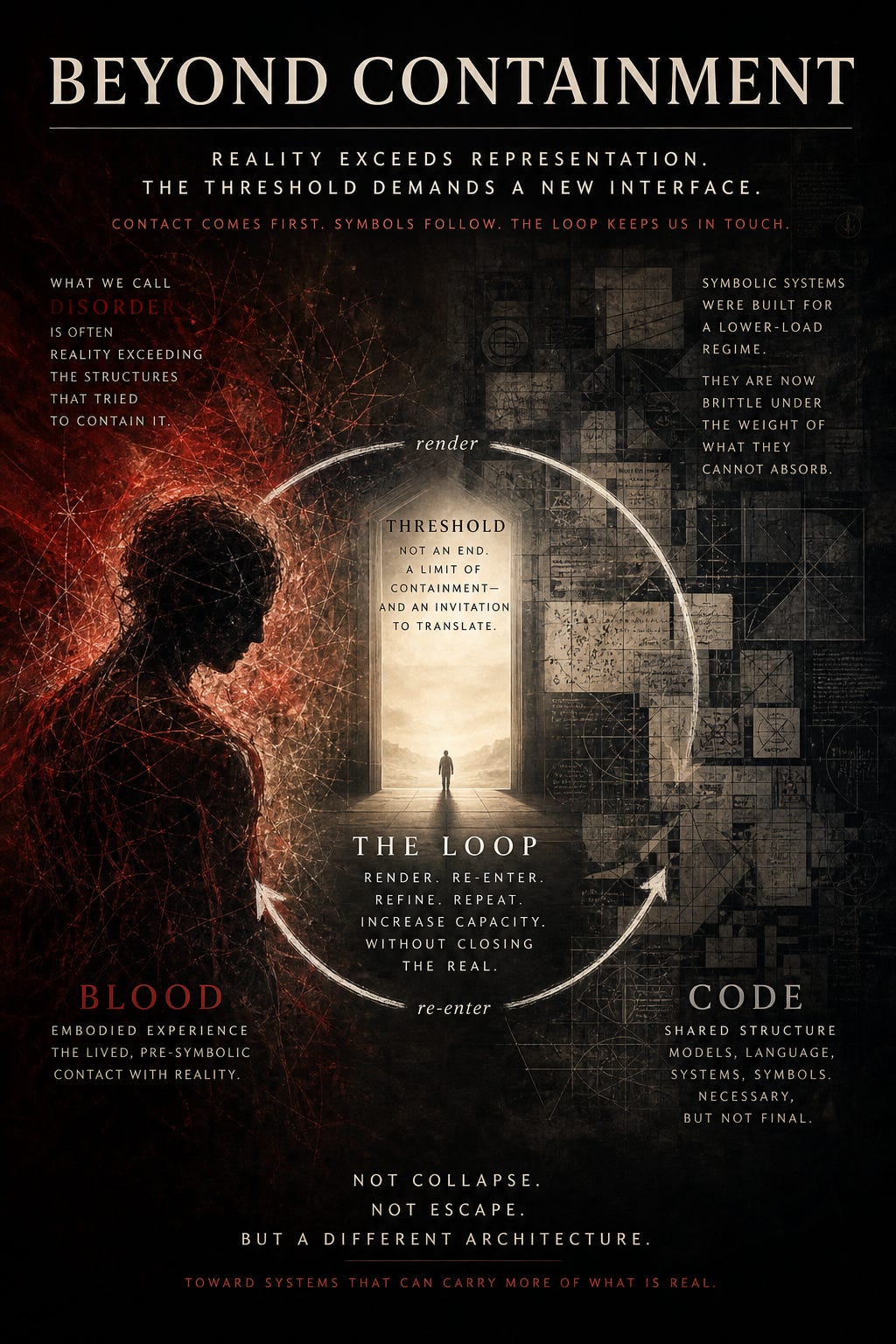
╔═════════════════════
║ BEYOND CONTAINMENT — MAP ║
╚═════════════════════
REALITY (CONTACT)
│
│ pre-symbolic, body-coupled, high-resolution
▼
[ EXPERIENCE ]
│
│ (cannot be fully captured)
▼
[ SYMBOLIC RENDERING ]
│
│ language / concepts / systems
│ → partial, usable, shareable
▼
[ SOCIAL COORDINATION ]
│
│ requires stability → compression
▼
[ SCL: SOCIAL COMPRESSION LAYER ]
│
├─ keeps: what is legible / stable / transmissible
└─ compresses: excess / variance / ambiguity
⇒ RESULT (historical equilibrium):
symbols ≈ sufficient → system feels stable
──────────────────────────────────────────────────────────────
NOW: LOAD ↑ (speed, density, interconnection)
CONTACT (Reality) > SYMBOLIC CAPACITY
⇒ MISMATCH
▼
[ BRITTLENESS ]
- rigidity (over-definition)
- fragmentation (multiple frames)
▼
[ REEMERGENCE ]
- compressed excess becomes visible
- “disorder” = uncontained reality
▼
[ THRESHOLD ]
- containment no longer sufficient
──────────────────────────────────────────────────────────────
THREE RESPONSES
1) OVER-COMPRESS
→ stricter symbols
→ short-term stability / long-term fracture
2) DROP STRUCTURE
→ pure fluidity
→ loss of coordination
3) TEMPLE (PROPOSED)
CONTACT → RENDER → RE-ENTER → REFINE → REPEAT
BLOOD (experience)
↓
CODE (structure)
↓
BLOOD (higher resolution)
⇒ compression becomes REVERSIBLE
⇒ capacity increases
⇒ excess is preserved (not eliminated)
──────────────────────────────────────────────────────────────
CORE AXIOM
Contact comes first
Symbols render it
Excess remains
Language ≠ container of reality
Language = routing layer for contact
──────────────────────────────────────────────────────────────
REFRAME
NOT:
“Reality is breaking down”
BUT:
“Symbolic systems can no longer fully contain it”
──────────────────────────────────────────────────────────────
FINAL
Problem = one-way compression
Solution = circulating rendering (loop)
Goal:
Maintain coordination
without reducing reality to what can be said
Process-based readings at points of threshold, emergence, and reconfiguration.
For those who feel something exceeding language.
I’m currently working on this close to full-time.
This is the phase where it moves out of text and into live use—tested, refined, and interacted with.
If you want to step into that layer, you can do that here.
Paid subscriptions on Substack/Patreon include direct work at the threshold.
Super cool to find this after talking with my brother about (both GLPs) the levels of reality sensing. Trying to see were does the symbolic order emerge. I understand it as the narrative our consciousness uses from language to understand raw hardware inputs from the body. Like a meaning, but then we can notice the delay there is between our gestalts and language/meaning formation. So my posture is that gestalts are inside of the simbolic order already, his is that not so much.. I'll share this post it will be fun XD
What is resurfacing is the knowledge that is generally called magic as a derogatory term. The fluid relationship between symbols and reality which you describe as optimal was the basis of the magic tradition.. so just as you describe there is nothing new- your own idea is resurfacing something and not a new one. Magic is returning and I for one think that's a good thing. But we are not returning to a primitive superstition or ignorance.- we have become wise. Like a religious child that becomes teenager atheist, but becomes spiritual later in life. Now our magic actually works according to the laws of physics and logic so it's much more repeatable.