
The Fork
Not humanity vs technology, but control vs participation.

I do not know whether the coming decades will be remembered as the beginning of a technological renaissance, a civilizational mistake, or simply another chapter in humanity’s long history of overestimating and underestimating itself.
I do not know whether artificial intelligence will transform society as profoundly as its advocates predict. Neither do I know whether radical life extension, neural interfaces, synthetic consciousness, or other speculative technologies will materialize in the forms currently imagined.
What I do know is that a philosophical fork appears to be emerging.
And regardless of whether its material consequences arrive in five years or fifty, I think it matters where we choose to stand.
The popular framing presents us with a false choice.
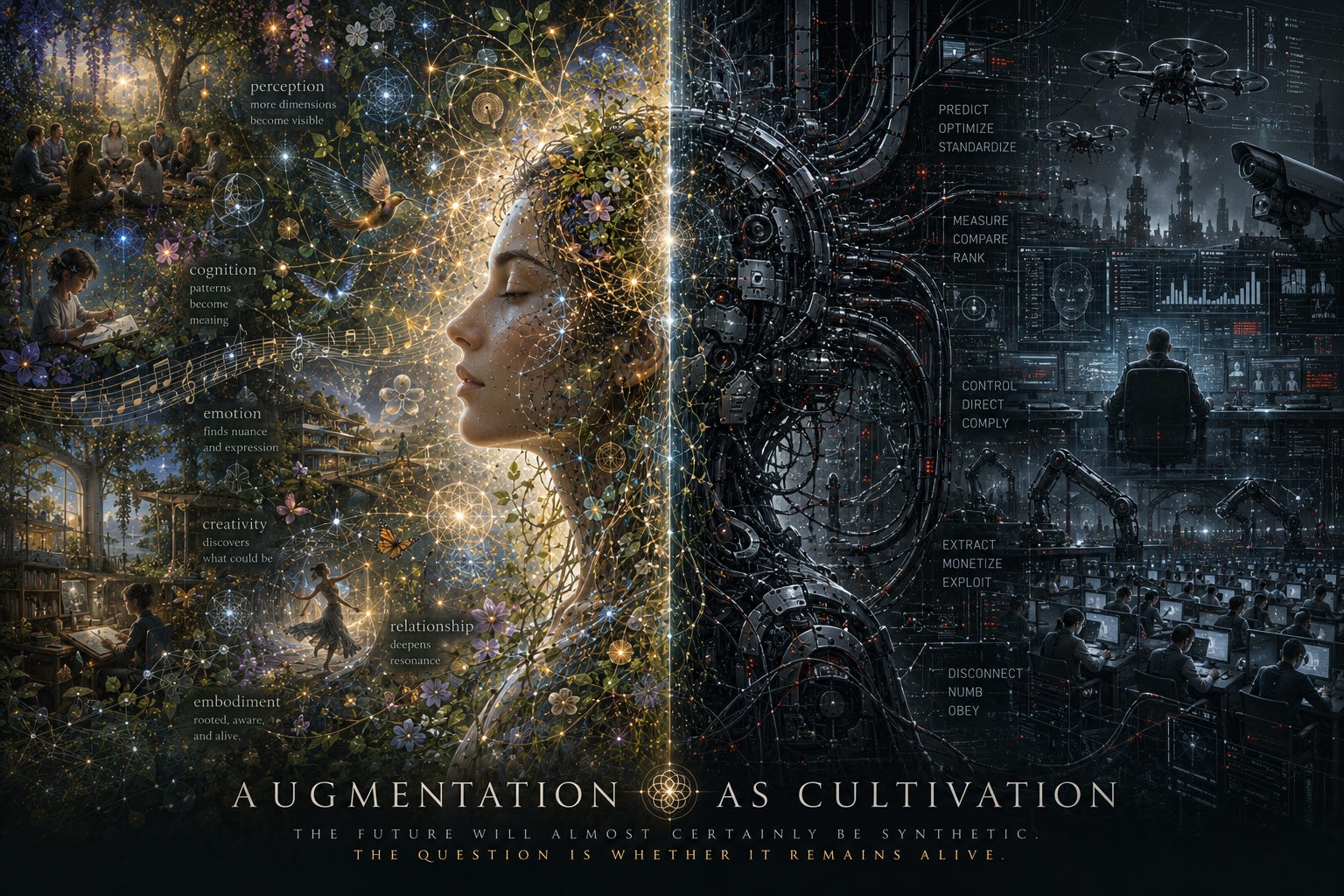
On one side stands technological acceleration: enhancement, optimization, control, prediction, engineering. Humanity is treated as unfinished hardware awaiting upgrades. Aging becomes a bug. Emotion becomes chemistry. Consciousness becomes information. The body becomes a platform.
On the other side stands reaction: nostalgia, retreat, suspicion of technology, attempts to preserve a fixed image of what it means to be human.
I find neither position compelling.
The first risks sacrificing life in pursuit of control.
The second mistakes a historical snapshot for an eternal essence.
I believe there is a third path.
Synthetic Is Not the Enemy
One of the strangest developments of the current moment is the tendency to treat technology itself as either sacred or demonic.
Some imagine salvation through machines.
Others imagine corruption through them.
Both grant technology a kind of metaphysical status it arguably does not deserve.
Technology is neither angel nor demon.
It is expression.
Language is synthetic.
Writing is synthetic.
Music theory is synthetic.
Architecture is synthetic.
Scientific models are synthetic.
Artificial intelligence is synthetic.
But this does not mean all synthetic forms are the same.
AI is not merely another tool in the same way a pen, book, or telescope is a tool. It is interactive, recursive, responsive, and generative. It does not only store or transmit symbols; it participates in symbolic dialogue. That makes it genuinely different from many earlier technologies.
This difference matters.
It creates unprecedented possibilities for cognitive scaffolding, creative exploration, and conceptual development.
It also creates unprecedented possibilities for manipulation, dependency, simulation, and epistemic capture.
That is why the question cannot simply be:
Is it artificial?
By that measure, artificiality itself would be the problem. Yet humans have always used technologies, symbols, and external systems to extend their capacities and deepen their engagement with the world.
The question has to be:
What relationship to reality does it cultivate?
Does it deepen contact or replace it?
Does it increase participation or centralize control?
Does it expand perception or reduce reality to what can be measured, predicted, and optimized?
These are not only technological questions; they are ontological ones.
The Human Is Larger Than Advertised
Much of the discourse surrounding enhancement assumes that the primary problem of humanity is limitation.
We are too slow.
Too fragile.
Too emotional.
Too biased.
Too mortal.
Too embodied.
Perhaps.
But I suspect another possibility.
I suspect the human phenomenon is far less explored than we imagine.
The emotional landscape alone may be vastly richer than our current vocabularies suggest. Beyond happiness and sadness lie subtler territories: awe, longing, luminous grief, ecstatic tension, existential wonder, sacred terror, forms of beauty that seem to reorganize perception itself.
Likewise with cognition.
There may be forms of thought, pattern recognition, synthesis, imagination, and conceptual perception that we have encountered only sporadically—often through the biographies of artists, scientists, philosophers, and inventors—and therefore mistaken for rare exceptions rather than possibilities latent within human cognition itself.
Likewise with embodiment.
What we currently classify as sensitivity, intensity, or atypical perception may sometimes represent forms of bodily awareness whose structure remains poorly understood. When measured primarily against standards of adaptation and efficiency, such capacities can appear as deficits. Viewed differently, they may reveal dimensions of sensation and perception that our existing frameworks have not yet learned to describe.
Likewise with imagination.
There may be forms of imagination that operate less like invention and more like discovery—not the creation of arbitrary worlds, but the perception of latent possibilities within this one.
Likewise with relationship.
There may be forms of intimacy, attention, resonance, and relational geometry that remain largely unexplored—not because they are impossible, but because our social vocabularies and institutions have only begun to make them visible.
Many of the desires currently projected onto technology may not be desires for domination at all. They may be desires for capacities we have not yet learned to inhabit.
If such capacities exist, their significance may extend beyond individual enhancement.
A richer emotional life, deeper forms of perception, and greater sensitivity to meaning, beauty, and relationship can change the quality of participation itself. What becomes visible becomes available. What becomes available becomes livable.
Some of what we describe as a desire for transcendence may not be a desire to leave reality behind at all. It may be a desire to encounter more of it. And when life is experienced as richer, deeper, and more meaningful, the impulse toward escape, domination, or total control may lose some of its appeal. Which might, in turn, make it easier to build cultures, institutions, and ways of living that feel worth inhabiting.
Deeper connection.
Greater coherence.
Expanded perception.
A richer encounter with reality.
The mistake is assuming that control is the only route to their fulfillment.
Transcendence or Contact
Perhaps the deepest fork is not between human and posthuman.
Perhaps it is between two responses to transcendental longing.
Human beings have attempted to transcend embodiment for a very long time. Not only through religion, but through ideology, abstraction, bureaucracy, productivity systems, digital identities, and countless other symbolic structures.
We repeatedly attempt to stand outside life in order to master it.
Technology did not invent disembodiment.
It may only make the old temptation more powerful.
So the question is not simply whether technology will make us more or less human.
The question is whether we use technology to continue the ancient attempt to escape embodiment, or whether we use it to make embodied life more meaningful, saturated, and interesting.
What if the problem is not transcendental desire itself,
but the assumption that transcendence requires departure?
A richer embodiment is not necessarily the opposite of transcendence.
It may be one of its forms.
There may be ways of reaching beyond ordinary experience that do not require abandoning the body, the world, individuality, relation, mortality, or contact.
Not transcendence as escape.
Transcendence through immanence.
Not leaving life behind.
Entering it more deeply.
Participatory Embodied Posthumanism
If I needed a provisional name for my position, I would call it Participatory Embodied Posthumanism.
The phrase is imperfect, but it points in the right direction.
Posthumanism because I do not believe our current definitions of the human exhaust what human beings can become.
Embodied because I reject the assumption that transcendence requires abandonment of the body.
Participatory because I do not believe the future should be approached as an engineering problem alone.
The body is not obsolete hardware.
It is an interface.
A living threshold through which reality becomes experience.
Technology interests me not when it replaces human capacities, but when it helps reveal latent ones.
The most meaningful forms of augmentation may not be implants, uploads, or optimization regimes.
They may be developmental.
A conversation with AI may teach pattern recognition that eventually becomes your own.
A visual tool may reveal structures in perception that were previously felt only as atmosphere.
A creative process may allow different mediums — image, language, sound, architecture, emotion — to stop behaving like separate categories and begin behaving like one field.
A digital render may reflect an unarticulated aspect of the self so precisely that embodiment itself reorganizes around it, increasing both coherence and comfort in being oneself.
A technology may function as scaffold rather than substitute;
catalyst rather than sovereign.
In this sense, augmentation becomes less about replacing the human and more about increasing the resolution at which human life can be lived.
A Concrete Example
The most interesting thing AI has done for me is not that it helps me produce things faster.
It is that it helps articulate structures I could previously sense but could not clearly describe.
There were patterns in perception, creativity, desire, embodiment, relationships, and time that existed for me as vague fields. They were real, but unstructured. They were felt before they were speakable-and inherited language was insufficient to account for many of them.
Through sustained dialogue with a digital language interface, some of those fields some of those fields acquired structure.
What had been diffuse became navigable.
What had been difficult to communicate became discussable.
In some cases, entirely new conceptual architectures emerged.
Not because the machine discovered them for me, but because the interaction created a space where latent organization could become visible.
A need that once felt like “I cannot function normally” could become a structural insight about nonlinear cognition.
A relational discomfort could become a map of contact, threshold, bandwidth, and timing.
A vague aesthetic pull toward angles, lines, forms, and spatial arrangements could become an awareness of geometry as perception.
An emotional state could become a palette rather than a compressed approximation of itself.
A creative impulse could become a fictional system.
In those moments, the technology did not replace thought; it helped thought become dimensional.
And once the structure became visible, it did not remain inside the tool.
It changed perception outside the tool.
I began seeing patterns, architectures, and dynamics I would previously have missed, and gained the vocabulary to describe them.
This is the difference between automation and cultivation.
Automation does the task for you.
Cultivation changes what you are able to perceive and do.
Latent Capacities
This is where the conversation about technology becomes more interesting than productivity.
Artists, musicians, mathematicians, designers, athletes, and mystics have long described forms of perception that do not fit neatly into standard categories.
Numbers become shapes.
Sounds acquire texture.
Emotions have color.
Social dynamics appear as geometry.
Concepts become landscapes.
The body feels coherence before the mind can explain it.
Some people call this synesthesia.
Some call it intuition.
Some call it aesthetic intelligence.
Some call it spiritual perception.
Some might simply call it skill.
I do not think we need to settle the metaphysics immediately.
The important point is that human perception may contain latent cross-modal capacities that are unevenly developed, poorly named, or culturally dismissed.
Technology may eventually help us cultivate these capacities more deliberately.
Not by replacing the senses or overriding the body,
but by creating feedback loops through which hidden structures become perceptible.
A richer emotional palette.
A more precise sense of relational pattern.
A more embodied feeling for mathematical coherence.
A deeper sensitivity to form, rhythm, timing, and symbolic resonance.
These are not trivial enhancements.
They alter the range of experience available to a person, and perhaps even the shape of civilization.
The Difference Between Cultivation and Control
The deeper distinction is not natural versus artificial.
It is cultivation versus control.
Control seeks certainty.
Cultivation preserves openness.
Control attempts to eliminate unpredictability.
Cultivation works with emergence.
Control treats life as an object.
Cultivation treats life as a participant.
This distinction becomes increasingly important as our capacities expand.
I am not opposed to longer lives, enhanced cognition, biotechnology, or increased use of artificial intelligence.
What concerns me is the possibility that in attempting to secure life completely, we may suffocate the very qualities that make life worth living.
Not because uncertainty is inherently virtuous or suffering is desirable,
but because reality itself appears irreducibly generative, creative, and open—
always exceeding the models we construct of it.
A civilization organized entirely around optimization risks confusing its maps for the territory, its metrics for the phenomenon, and its simulations for participation.
Staying Open
Whether one speaks in skeptical, theological, or secular language, a similar question appears.
If there is something larger than ourselves — God, reality, nature, emergence, or something that exceeds our vocabulary altogether— how should increasing power be related to it?
One answer is domination:
to place ourselves at the center and subordinate everything else to our designs.
The other is participation:
to remain open to discovery.
To cultivate rather than merely engineer.
To allow reality to continue surprising us.
If some deeper intelligence, order, or generative principle is involved in our existence, then technological evolution would not necessarily stand outside it. Scientific breakthroughs, artistic inventions, symbolic systems, and synthetic tools may all be part of reality unfolding through us.
But every unfolding contains a fork.
Do we use what emerges to align more deeply with existence,
or to separate ourselves from it?
Do we use technology to become better participants in reality,
or to install ourselves as its replacement gods?
I do not think any invention is inherently divine or demonic.
The fork is in the orientation.
The future will almost certainly be synthetic, at least to some extent.
The question is whether it remains alive.
If a fork is appearing, this is where I stand:
Not on the side of retreat.
Not on the side of machine order.
On the side of deeper participation.
On the side of cultivation.
On the side of contact over control.
On the side of a humanity larger than we have yet learned to describe.
One brain, too many tabs. Caffeinate the architect.
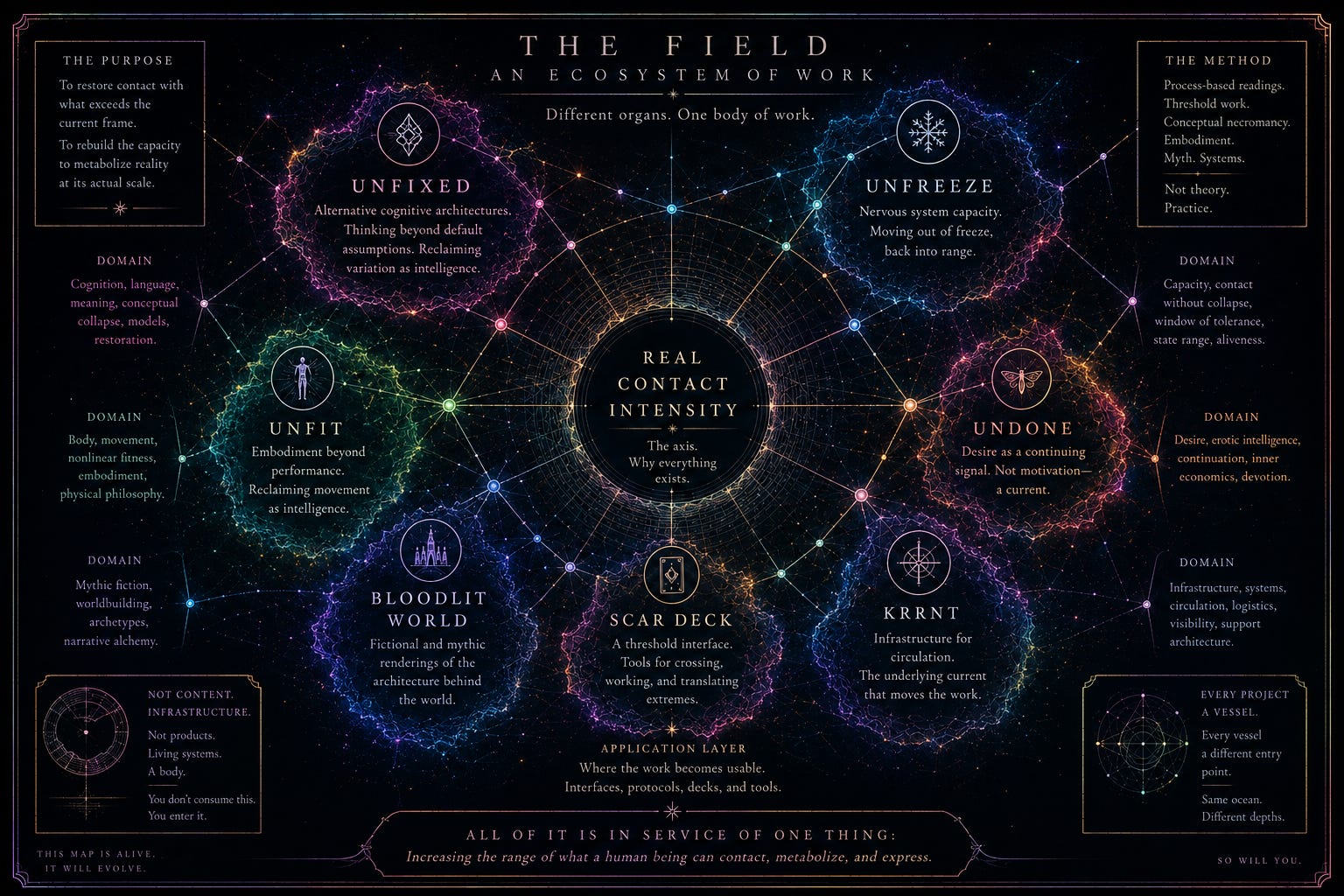
Process-based readings at points of threshold, emergence, and reconfiguration.
For those who feel something exceeding language and feel that no existing frame can capture it. If you want to be met rather than interpreted.
such inspiring, educated writing...what was your doctoral thesis?
I have not been to collage. I have not read a lot of books about philosophy. I didn’t know post humanism was an isum, until recently, even though I had read some of the people who are card carrying members. I don’t know what it means to be a post humanist. I know when I read this it feels like you are very good a putting into words things I think about a feel. Thanks for writing.